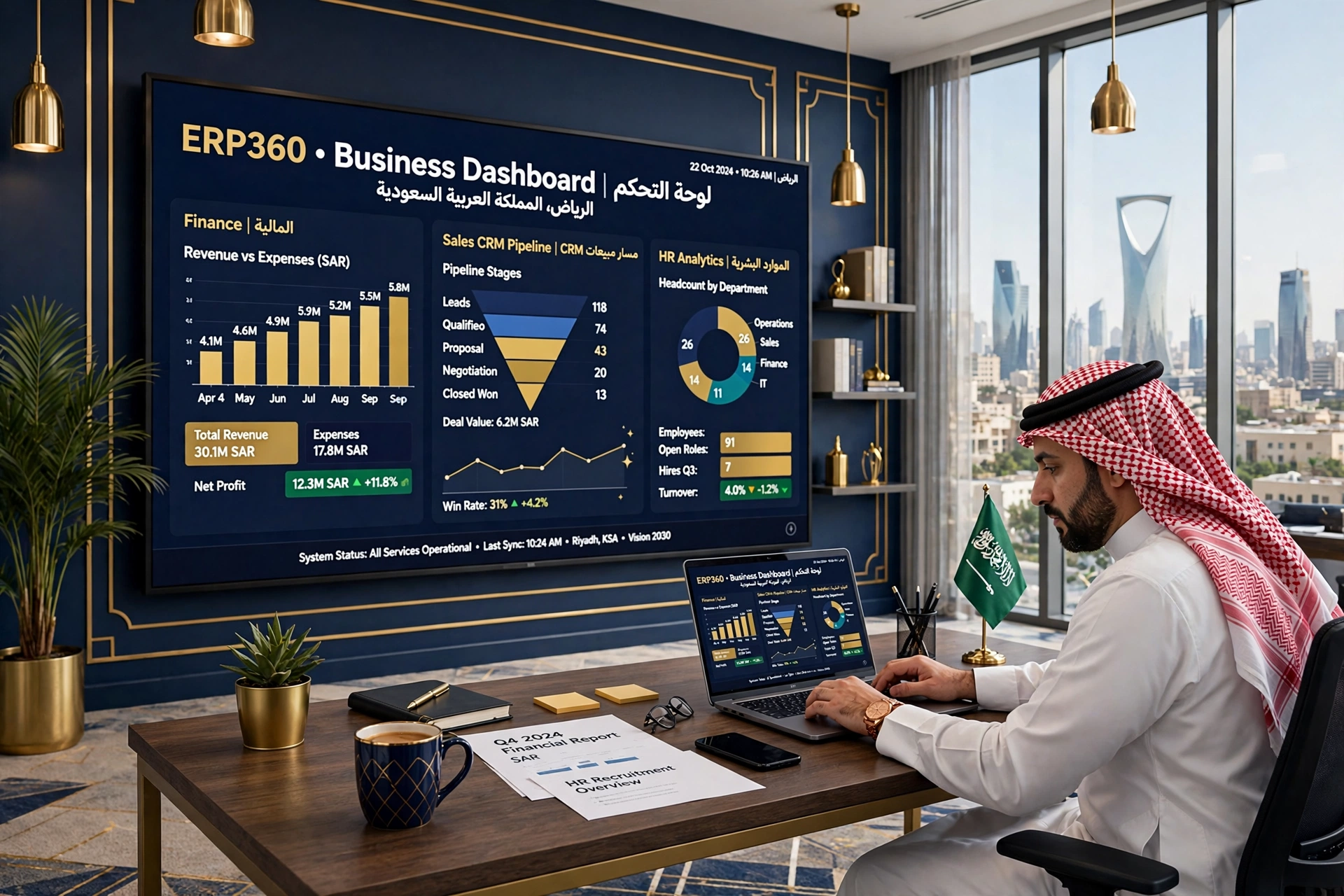
A growing Saudi business rarely has a software problem — it has a systems problem. Sales keeps its own records, finance keeps its own, HR keeps its own, and nobody’s numbers quite agree. The business ends up paying people to reconcile its own information instead of using it.
ERP, CRM and HRM exist to end that. Three systems, one idea: every department working from the same truth. MBKS Global builds comprehensive resource planning and management systems — ERP, CRM and HRM — tailored to local regulations and organisational workflows, so the system fits the business instead of the business bending around the system.
ERP, CRM and HRM — Three Names, One Purpose
The three letters get mixed up, so the difference matters. ERP — enterprise resource planning — is the business’s backbone: finance, operations and resources in one place. CRM — customer relationship management — is the business’s memory for customers: who they are, what they asked for, and where each sale stands. HRM — human resource management — is the business’s record for its people: staff, roles and the workflows around them.
They answer different questions, but they share one job: stop the same information living in three places. When they work as one connected system, a sale, a staff change and a finance entry all draw on the same data — and the numbers stop disagreeing with each other.
ERP: Finance and Operations in One Place
An ERP brings the running of the business together. Instead of finance in one tool, operations in another and stock or service records in a third, the business works from one system where entries are made once and seen everywhere they are needed.
The value is not the software itself — it is what disappears. Duplicate entries disappear. The end-of-month hunt for which spreadsheet is current disappears. And the manager’s question “which figure is right?” starts having one answer instead of three. For a Saudi business, that only works if the ERP is built around local rules and local workflows — which is exactly how MBKS Global builds them: tailored to local regulations and organisational workflows, not imported as a template.
CRM: Every Customer, Every Conversation, in One Place
A CRM is where customer relationships stop depending on memory. Every enquiry, every quotation, every follow-up and every sale sits in one place, so a customer never has to repeat themselves — and a sale never depends on one person remembering to chase it.
For businesses selling across Riyadh, Jeddah and Dammam, that matters twice over: more customers, more conversations, and more chances for one to slip through. A CRM built for the Saudi market also has to speak the customer’s language — full Arabic support and interfaces designed Right-to-Left from scratch, so the system feels native to the people using it, not translated for them.
HRM: Your People, Organised Like Your Business Depends on It — Because It Does
An HRM keeps the people side of the business in order: staff records, roles and the workflows that surround them. In a camp, a construction firm or a growing services company, the people are the operation — and an HRM that lives apart from finance and operations forces the same details to be entered twice.
Connected to the ERP and CRM, the HRM stops being a filing cabinet and becomes part of the system: the same staff, the same structure, the same data, used by the departments that need it. MBKS Global builds these systems as part of one connected whole, tailored to how the organisation actually works.
The Real Cost of Separate Systems
Separate systems do not fail loudly. They fail quietly, every day: the same customer entered three times with three spellings, a payment recorded in finance but not in sales, a staff change that reaches HR but never reaches the roster. Each one is small. Together, they are a second job the business never hired anyone for.
Spreadsheets bridging the gaps make it worse, not better — they are the workaround that becomes permanent. A connected ERP, CRM and HRM removes the bridges by removing the gaps: one entry, one record, every department reading the same thing.
One Connected System: Why Integration Beats Collection
Collecting three good tools is not the same as having one system. Tools that do not talk to each other still need people to carry information between them — and people are where errors creep in.
A connected system earns its keep in the handoffs: a sale in the CRM flows into the ERP without re-typing, a workflow in the HRM triggers the steps that follow it without chasing. MBKS Global pairs these systems with workflow automation — streamlining complex business processes to reduce manual effort and operational costs — and with robust API architecture, connecting the software with ZATCA, payment gateways and third-party tools, so the pieces of a business talk to each other instead of being re-typed between them.
Built for Saudi Regulations, Not Adapted to Them
A system built for another country arrives with the wrong assumptions: the wrong tax logic, the wrong working patterns, the wrong ideas about where data may live. MBKS Global’s starting point is the Kingdom itself — robust systems that respect local data regulations and user behaviours, from government integrations to high-traffic consumer apps.
That shows up in the build, not just in the brochure. Local data rules shape where the system runs and how it is hosted. Local workflows shape how approvals, records and reporting actually work. And local users shape the interface — user experiences tested with Saudi users, so the product feels native rather than translated.
Your Data Stays in Saudi Arabia
For Saudi businesses, where data lives is a compliance requirement, not a technical preference. MBKS Global prioritises hosting on local Saudi clouds, including STC and DETASAD, to keep data within borders, in compliance with NDMO and NCA regulations — and deploys strictly to Saudi-based data centres, such as Oracle Jeddah and Riyadh cloud regions or STC, to ensure full compliance with the Kingdom’s data residency laws.
An ERP, CRM or HRM holds the business’s most sensitive information — its money, its customers, its people. Keeping it in the Kingdom, under the Kingdom’s rules, is part of what the system is, not an add-on to it.
Government Integrations: Nafath, ZATCA and Muqeem
Saudi businesses do not operate apart from the government — they operate through it. MBKS Global builds seamless API connectivity with national platforms like Nafath, ZATCA for e-invoicing, and Muqeem, so enterprise processes run without manual handoffs.
ZATCA Phase 2 shows why this belongs inside the system rather than beside it. MBKS Global’s backend systems are designed to generate ZATCA-compliant XML invoices and handle the cryptographic stamping Phase 2 requires — the invoicing simply works, inside the ERP, instead of living in a separate tool that someone has to reconcile. One client put it plainly on the MBKS Global site: “They built a custom logistics dashboard that integrated perfectly with ZATCA for invoicing. It transformed our Riyadh operations.” — Ahmed Al-Harbi, CTO, Saudi Logistics Co.
Arabic-First and Mobile-First, Because Your Staff Work That Way
A system your staff fight is a system that fails, however good it looks on paper. So MBKS Global designs interfaces Right-to-Left from scratch, with Arabic typography such as Tajawal and Cairo rendering perfectly across all devices — and builds mobile solutions designed for the Saudi market with full Arabic support, optimised for 5G networks in Riyadh and Jeddah.
Most Saudi staff and customers meet a business on their phone first. An ERP, CRM or HRM that works properly on mobile — fast, Arabic-native, steady under real use — is not a nice extra. It is how the system actually gets used, every day, by the people it was built for.
From One System to a Business That Scales
MBKS Global has built more than 50 enterprise systems, and the pattern behind them is the same: start from the business, respect the Kingdom’s rules, build in Arabic first, and keep the data in Saudi Arabia. An ERP, CRM and HRM built that way does not just organise today’s business — it is ready for the business it becomes, without a rebuild when the team doubles or a new branch opens.
The maintenance does not stop at launch, either: 24/7 support plans keep digital assets secure, updated and running smoothly during peak seasons such as Ramadan and Hajj. A business system is a living system, and it is supported like one.
Ready to Bring Your Departments Into One System?
If sales, finance and HR are each keeping their own version of the truth — or if spreadsheets are bridging gaps between tools that should already talk to each other — it is time for one connected system. Talk to MBKS Global about an ERP, CRM and HRM built around your workflows, your regulations and your language.


