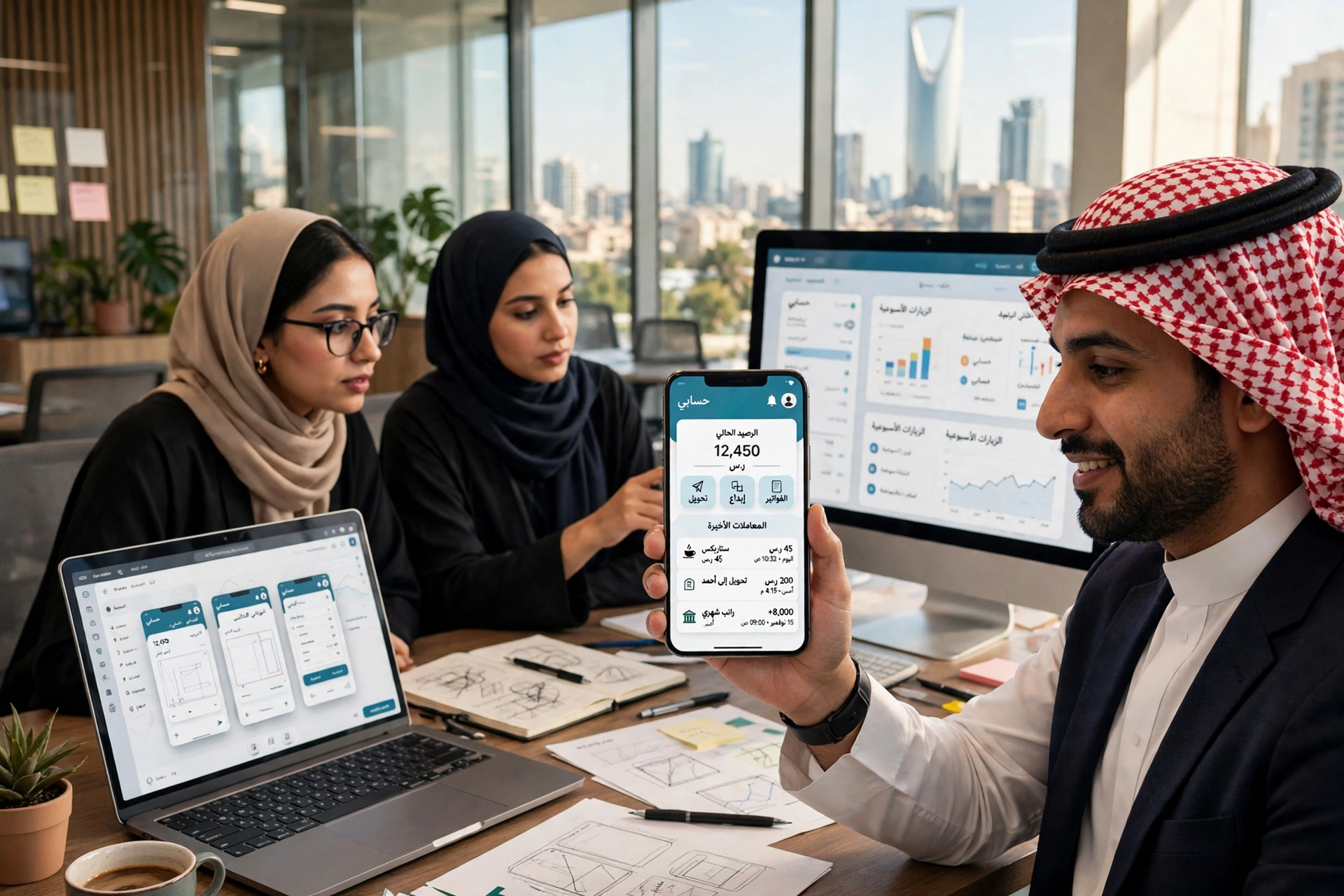
Most Saudi customers meet a business on their phone first. Not on a desktop, not through a phone call — on an app, in Arabic, paying with Mada, expecting it to just work. A business without an app is not invisible, but it is one tap further away than its competitors, every single day.
MBKS Global builds mobile apps for the Kingdom: native iOS and Android apps, and cross-platform apps in Flutter and React Native. The page’s own numbers say 150+ apps launched and 1M+ total downloads — this blog is about what goes into an app that earns those numbers, and what to look for before you build one.
Request a Free Technical Consultation
Your Customers Live on Their Phones
In Saudi Arabia the phone is the shop, the bank, the office and the ticket counter. From fintech in Riyadh to e-commerce in Jeddah, the businesses winning customers are the ones that turned their idea into a high-performance digital product people carry everywhere.
An app is not a smaller website. It is a different relationship: your business sits on the customer’s home screen, sends the right notification at the right time, and remembers who they are. That is why the question is rarely whether to build an app — it is what kind of app, and who builds it properly.
Native iOS: Swift Apps for the Apple Ecosystem
For iPhone users, MBKS Global builds native Swift applications tailored for the Apple ecosystem. Native means the app is built with Apple’s own tools, for Apple’s own phones — so performance, security and smooth animations are guaranteed, as the page puts it.
That matters most for apps where feel is the product: fintech, where a laggy screen destroys trust; retail, where a stuttering checkout loses the sale; any app where the customer judges the business by how the app moves. Native iOS is the no-compromise choice when the experience has to be flawless.
Native Android: Kotlin Across Every Device in KSA
Android in Saudi Arabia is not one phone — it is a wide range of devices, prices and screen sizes. MBKS Global builds robust Kotlin-based apps that run perfectly across that diverse range.
Kotlin is Google’s modern language for Android, and building natively in it means the app can use everything the phone offers, without the compromises of a lowest-common-denominator build. For a business whose customers are spread across every Android brand on the Saudi market, that coverage is the point.
Cross-Platform: One Codebase, Both Stores
Not every app needs two separate native builds. MBKS Global also builds Flutter and React Native solutions that give near-native performance on both iOS and Android with a single codebase.
The trade-off is honest and the page’s own FAQ states it plainly: native (Swift/Kotlin) offers the best performance for complex apps, while cross-platform (Flutter) is faster to build and cheaper, and great for startups. The right choice depends on the app — its complexity, its budget and its deadline — and MBKS Global helps you decide rather than selling one answer to everyone.
RTL-First UX/UI: Arabic Designed From the Ground Up
This is where most apps built for Saudi Arabia fail. They are designed in English, then flipped. MBKS Global designs intuitive Arabic interfaces (RTL) from the ground up — the page is explicit: “We don’t just flip the screen.”
RTL-first means the layout, the navigation, the reading order and the visual hierarchy are all designed for Arabic first. The result is an app that feels natural to a Saudi user instead of translated. One client put it plainly on the MBKS Global site: “Our users love the new UI. It’s clean, modern, and works perfectly in Arabic. Highly recommended for app development.” — Layla Ahmed, Product Manager, RetailApp.
The design work itself runs through wireframing, prototyping and high-fidelity designs, focused on user retention and ease of use — because an app people cannot navigate is an app people delete.
Local Payments: Mada, STC Pay, Apple Pay and More
An app that cannot take the customer’s money is a brochure. MBKS Global integrates Mada, STC Pay and Apple Pay, plus local gateways HyperPay and Moyasar, for frictionless transactions.
This is not a detail to add at the end. Payment is where Saudi customers decide whether they trust you: Mada is the card in their wallet, STC Pay is the wallet on their phone, Apple Pay is the tap they already use everywhere else. As one client said on the MBKS Global site: “The app they built is incredibly fast. The Mada integration was flawless, which was critical for our Saudi customers.” — Khalid Al-Saud, Founder, QuickPay KSA.
Backend & APIs: The Engine Nobody Sees
A beautiful app on a weak backend is a fast car with no engine. Behind every MBKS Global app sit secure RESTful APIs, cloud database management (Firebase, AWS) and efficient server-side logic.
This is the part customers never see and always feel: logins that work, data that syncs, orders that arrive, accounts that stay secure. It is also what makes the app maintainable — clean server-side logic means new features can be added later without rebuilding what already works.
Built for Kingdom Scale: Ramadan Surges and 99.9% Uptime
Developing in Saudi Arabia means understanding unique local requirements, and scale is one of them. Traffic does not arrive evenly through the year — it surges during Ramadan and local holidays. MBKS Global builds apps whose cloud infrastructure scales automatically to handle those surges, with 99.9% uptime stated on the page.
That is the difference between an app that works on a quiet Tuesday and an app that works when everyone in the Kingdom opens it at once. The page also states 50K+ active users with rising retention across iOS and Android, and 24/7 tech support behind the apps it builds.
How We Build Your App: Discovery to Launch
MBKS Global follows a proven agile workflow to go from concept to app store, in four steps:
- Discovery — defining technical requirements, user flows and core features.
- Design (UI/UX) — creating interactive prototypes and high-fidelity visuals.
- Development — agile coding sprints with regular updates and quality assurance (QA).
- Launch & Scale — deployment to the app stores and post-launch performance monitoring.
Agile sprints matter because they mean the client sees the app growing instead of waiting months for a reveal. Regular updates and QA through the build catch problems while they are still cheap to fix.
Request a Free Technical Consultation
App Store Submission, Handled
Getting into the stores is a project of its own — Apple’s guidelines, Google Play’s rules, screenshots, descriptions, review rejections. MBKS Global handles the entire submission process for both the Apple App Store and Google Play Store, ensuring the app meets all guidelines.
For a business owner, that removes the most frustrating part of launching an app: the back-and-forth with reviewers over a guideline nobody warned you about. And the work does not stop at launch — MBKS Global provides ongoing maintenance and support: bug fixes, OS updates and feature enhancements, because phones update and apps must keep up.
How Long Does It Take to Build an App?
The page’s own FAQ answers this directly: a basic MVP typically takes 3–4 months, while a complex enterprise app can take 6+ months, with a detailed timeline provided during the discovery phase.
That range is the honest answer, and it is worth knowing before you start. An MVP in 3–4 months gets a real product into real customers’ hands; a 6+ month enterprise build covers the integrations, roles and compliance a large organisation needs. Either way, the timeline is set during discovery — after the requirements are defined, not before.
The Proof: 150+ Apps, 1M+ Downloads, and Three Client Stories
The page states 150+ apps launched, 1M+ total downloads, 99.9% uptime and 24/7 support. Those are the page’s own figures, and they are backed by named clients:
- “The app they built is incredibly fast. The Mada integration was flawless, which was critical for our Saudi customers.” — Khalid Al-Saud, Founder, QuickPay KSA.
- “Our users love the new UI. It’s clean, modern, and works perfectly in Arabic. Highly recommended for app development.” — Layla Ahmed, Product Manager, RetailApp.
- “Professional code quality and excellent project management. We launched on time and within budget.” — Yousef Nasser, CTO, LogiTech.
Before you build, ask any app developer these questions: native or cross-platform — and why, for your app? Is the Arabic design RTL-first or flipped? Which local payments are integrated? Who handles App Store submission, and who maintains the app after launch? If the answers are vague, the app will be too.
MBKS Global’s answer, from its own page, is specific on every one of them — and the first step is a free technical consultation and estimate.
Request a Free Technical Consultation


