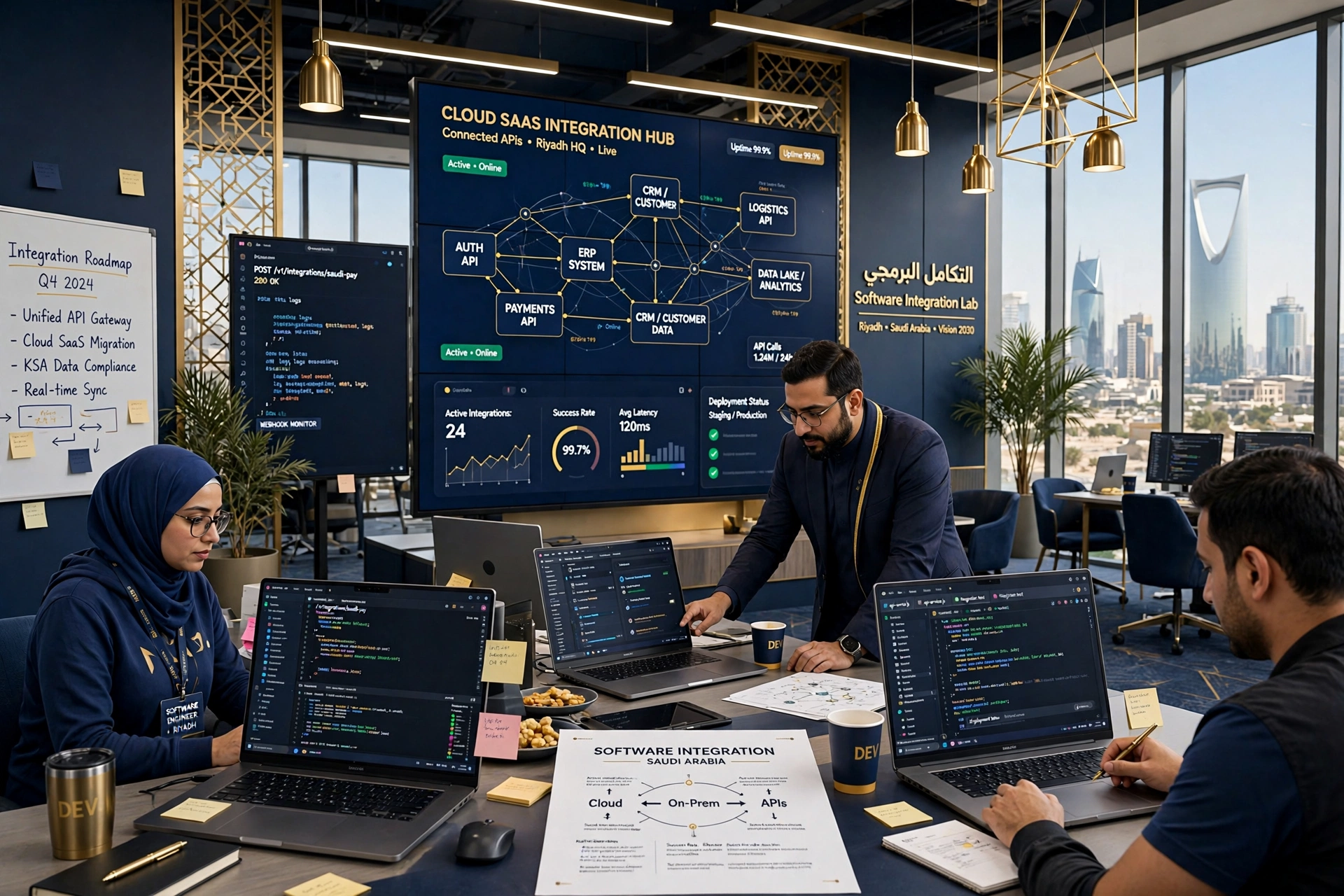
Most Saudi businesses do not have a software problem. They have a connection problem. The accounts system does not talk to the CRM. The online store does not talk to the warehouse. The invoice is raised in one place, stamped for ZATCA in another, and reconciled by hand in a third. Each system works on its own — and the business pays a person to carry information between them.
That is what API and SaaS development fixes. APIs are the connections between systems. SaaS is software built to be used by many customers, from one platform, without each one buying and running their own copy. MBKS Global builds both: robust API architecture and integration services, connecting software with ZATCA, payment gateways and third-party tools — and end-to-end development of scalable, multi-tenant Software-as-a-Service products, from MVP to enterprise launch.
What API and SaaS Actually Mean
An API is an agreed way for two systems to exchange information: one system asks, the other answers, in a format both understand. When a customer pays online, an API tells the accounts system the payment arrived. When a delivery is booked, an API tells the warehouse system what to pick. Nothing is re-typed, so nothing is mistyped.
SaaS is different: it is the product itself. Instead of software installed on one company’s computers, a SaaS product runs in the cloud and serves many customers, each with their own data and settings. The business that owns it sells access, not copies — and every customer gets the same updates at the same time. MBKS Global builds both the connections and the products, and the two often go together: a SaaS product that connects to a customer’s ERP, to ZATCA, and to a payment gateway.
Why Saudi Businesses End Up With Disconnected Systems
It rarely happens by choice. A business buys an accounting package one year, a CRM the next, and a separate tool for HR. A store opens on Salla or Zid while the warehouse still runs on spreadsheets. Each purchase solved the problem in front of it — and each one added a gap that a member of staff now fills by hand.
The cost shows up quietly: an order entered twice, a payment matched a day late, a stock figure that is wrong in one system and right in another. The fix is not another system. The fix is connections — APIs that let the systems the business already has share the same facts, in real time.
APIs: The Wiring Between Your Systems
MBKS Global describes its API work plainly: robust API architecture and integration services, connecting your software with ZATCA, payment gateways, and third-party tools. That wiring is what turns separate systems into one operation.
A good API connection does three things. It moves the right data, and only the right data. It moves it at the right time — when the event happens, not at the end of the week. And it fails safely: if one system is down, the work waits instead of disappearing. That is the difference between an integration and a hope. A business that connects its CRM, its ERP and its store stops asking staff to be the connection, and starts trusting its own numbers.
ZATCA, Nafath and Muqeem: Government Integrations That Cannot Be an Afterthought
In Saudi Arabia, some connections are not optional. MBKS Global builds seamless API connectivity with national platforms like Nafath, ZATCA for e-invoicing, and Muqeem, so enterprise processes run without manual handoffs.
That matters twice over for APIs. First, because compliance runs through these platforms: identity verified through Nafath, invoices generated as ZATCA-compliant XML with the cryptographic stamping Phase 2 requires, workforce records flowing to Muqeem. Second, because these integrations have to be designed in from the start — a system built without them needs to be rebuilt around them later. One client on the MBKS Global site put it simply: “They built a custom logistics dashboard that integrated perfectly with ZATCA for invoicing. It transformed our Riyadh operations.” — Ahmed Al-Harbi, CTO, Saudi Logistics Co.
Payments That Convert: Mada, STC Pay, Apple Pay and Local Gateways
A Saudi customer who cannot pay the way they prefer does not finish the purchase. MBKS Global integrates local payments — Mada, STC Pay, Apple Pay, and local gateways like Moyasar and HyperPay — for higher conversion.
For an API project, the payment gateway is one of the most valuable connections to get right. The payment, the invoice, the order and the stock record should all update from the same event, automatically. When they do, the business stops chasing payments and starts seeing them land, matched, in the accounts. When they do not, someone reconciles by hand — and every manual reconciliation is a chance to get it wrong.
From an Idea to a SaaS Product: MVP to Enterprise Launch
SaaS product development, as MBKS Global offers it, runs end to end: from MVP to enterprise launch. The MVP — the smallest version that real users can actually use — answers the only question that matters at the start: does anyone want this? If they do, the product grows; if they do not, the business has learned cheaply.
That staged approach is what makes SaaS affordable to start. The product does not need every feature on day one. It needs the core workflow working, for real users, in Arabic and English, on a phone. Everything after that is driven by what those users actually do, not by what was guessed in a meeting.
Multi-Tenant SaaS, Explained Simply
Multi-tenant is the word MBKS Global uses for its SaaS products, and it is simpler than it sounds. One product, one codebase — but each customer gets their own separate space inside it, with their own users, their own settings and their own data. Nobody sees anyone else’s information.
That is why SaaS scales the way it does. When the product improves, every customer gets the improvement. When a new customer joins, there is no new installation to build — they get their own space in a product that already works. And because the product is built once and sold many times, the cost of building it is spread across every customer who uses it.
Data in the Kingdom: Residency, NDMO and NCA
Where data lives is a compliance question in Saudi Arabia, and MBKS Global builds around it: compliance with NDMO and NCA regulations, with hosting prioritised on local Saudi clouds such as STC and DETASAD to keep data within borders. The Software page’s FAQ states it plainly — deployment strictly to Saudi-based data centres, such as Oracle Jeddah and Riyadh cloud regions or STC, to ensure full compliance with the Kingdom’s data residency laws.
For a SaaS product, this is a selling point as much as a requirement. A Saudi customer asking where their data is stored gets a clear answer: in the Kingdom, on local infrastructure. A product that cannot answer that question will lose to one that can, whatever its features.
Arabic-First, Mobile-First: Why Local Users Leave Bad Software
A SaaS product for Saudi users has to feel Saudi. MBKS Global designs interfaces Right-to-Left from scratch, so Arabic typography renders perfectly, and builds mobile apps with full Arabic support. Its software is optimised for 5G networks in Riyadh and Jeddah, with PWA capabilities for app-like experiences without the download friction.
That is not decoration. Users judge a product in seconds, on their phone, in Arabic. One client on the site describes a mobile app that “handles over 10k daily users without a glitch. The Arabic UX is intuitive and feels native.” — Sara Malik, HR Director, Jeddah Construction. A product that feels translated will be abandoned; a product that feels native will be used.
Super Apps and High-Traffic Platforms: Built for Scale
Some products have to work for everyone at once. MBKS Global builds scalable mobile ecosystems similar to Tawakkalna or Careem, designed for high concurrency and dual-language use — and custom web applications, complex SaaS platforms, HR portals and CRM dashboards built with React, ensuring data residency compliance.
Scale is a design decision, not a later fix. A product that works for a hundred users and breaks at ten thousand was not built for its market. Building for high concurrency from the start — the architecture, the hosting, the way data is stored — is what lets a product grow from an MVP into a platform without being rebuilt halfway there.
What Good API and SaaS Development Looks Like
Good development starts with the business problem, not the technology. MBKS Global states it on the Software page: stack-agnostic, specialising in JavaScript (React and Node.js), Python (Django and FastAPI) for AI, and native mobile technologies — choosing the best tool for the specific business problem. Its record on the page is 50+ enterprise systems.
The shape of a good project follows from that. Web portals and secure platforms built with modern frameworks. E-commerce stores or integrations with Salla and Zid, handling inventory sync, logistics APIs and payment flows. Corporate websites for government entities, contracting firms and enterprises. And after launch, 24/7 support plans to keep digital assets secure, updated and running smoothly during peak seasons such as Ramadan and Hajj — because a SaaS product is never finished, it is maintained.
How to Start: Request a Free Consultation
The starting point is a conversation about the systems a business already has, and the connections it is missing. Which systems need to talk to each other? Which government platforms have to be connected? Is the goal to connect what exists, or to build a product that other businesses will use?
MBKS Global serves Riyadh, Jeddah, Dammam and beyond, and the consultation is free. If the business already has systems that do not talk to each other, or an idea for a product that should exist as SaaS, that conversation is the next step — before another year of re-typing fills the gap that an API should have filled.


