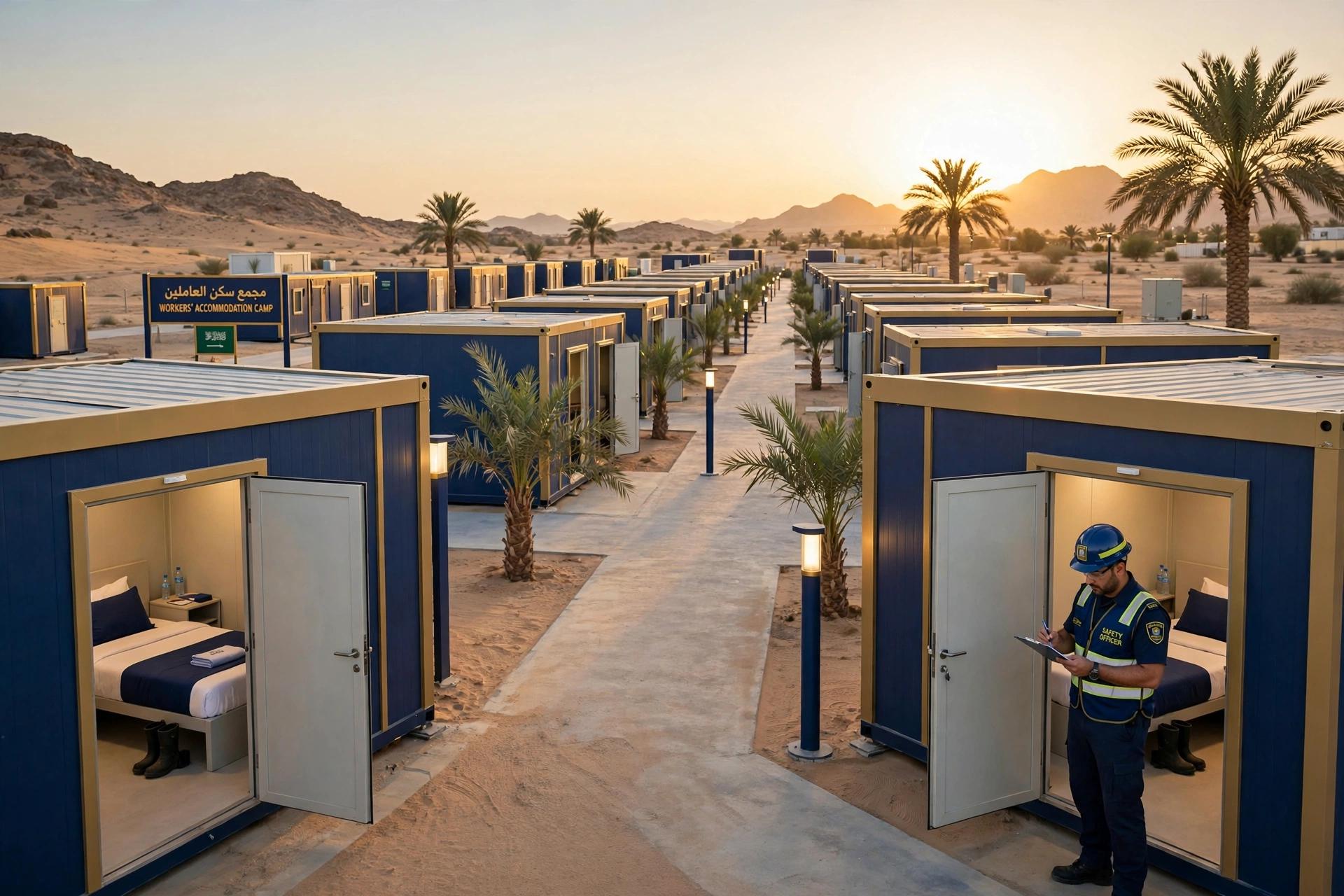
A worker’s bed is not a detail. In Saudi Arabia, it is a compliance record. How many workers sleep in a room, how much space each one has, whether the roster matches the beds — these are the questions a labour inspector asks, and the answers have to be ready on the day, not reconstructed from spreadsheets afterwards.
That is what worker welfare compliance means in practice. Not a policy document on a shelf, but live records that prove, at any moment, that your camp meets the standards. CampWise was built for exactly that — and this blog explains how, using only what the CampWise page itself states.
Request a free 30-minute tour of CampWise here — https://mbksglobal.com/camp-management-software-campwise/
Why Worker Welfare Is Now a Compliance Issue, Not a Courtesy
Worker welfare in Saudi camps used to be treated as good practice. Today it is a compliance matter. Clients audit it, HSE teams inspect it, and government labour inspections check it — and the standards they check against are written down: KSA municipal and Ministry of Human Resources standards, including square-footage capacity limits for bed allocations.
That changes what a camp operator needs. A camp that is genuinely well run but cannot prove it on paper is in the same position, on inspection day, as a camp that is not well run at all. Welfare has to be visible in the records — live, accurate and ready to show.
What MHR and Municipal Standards Actually Require
The CampWise page states the standard plainly: bed allocations are checked against KSA municipal and Ministry of Human Resources standards, including square-footage capacity limits. In plain terms, that means each worker’s bed has to fit within the space the rules allow — rooms cannot simply be filled until they are full.
The practical consequence is a number that has to be right every day, not just on audit day. How many beds does a room hold under the standard? How many are occupied right now? Is the camp over capacity anywhere, even by one bed? A spreadsheet updated weekly cannot answer those questions. A live system can.
Beds, Space and the Square-Footage Rule
Capacity is not a feeling; it is arithmetic. CampWise runs on an unbreakable relational chain — a Location contains one or more Camps, a Camp contains Buildings and Blocks, and Buildings contain Floors with Rooms — so occupancy can be calculated instantly at any level, from a single floor to all camps combined.
That structure is what makes the square-footage rule enforceable in daily work. When a room is assigned, the system knows its capacity; when a worker checks in, the numbers update instantly; and because the data is live — the page states 100% real-time capacity tracking — the occupancy figure an inspector sees is the occupancy figure right now, not last week’s.
Peak Summer: When Welfare Rosters Get Tested
If there is one season that tests a camp’s welfare records, it is peak summer. Shift rotations change, workers move, and rosters have to keep up — and the CampWise page states that peak-summer shift rotations produce audit-proof welfare rosters.
That phrase matters. An audit-proof roster is not just a list of names; it is a roster that can be checked against the beds, the rooms and the standards, and still hold together. When rotations move workers between buildings, the live database updates with each move, so the roster and the beds never drift apart — and the page reports 99.4% roster accuracy and zero spreadsheet errors.
One Record per Worker: Iqama, Room and Bed
Welfare compliance starts with knowing who is where. CampWise keeps precise personnel records — National ID, Iqama and passport documentation — with each worker linked to a room and a bed through the chain above. No room exists without a building, no building without a camp: the chain has zero orphan records.
That matters for welfare because an inspector’s first question is usually the simplest one: show me where this worker sleeps. With one connected record, the answer is a search, not a hunt through files. CampWise offers instant search by name, ID or phone, and the AI Operations Assistant can locate personnel across 20+ buildings from a plain-English question.
Facilities Are Not Beds: Why the Split Matters for Audits
A camp has rooms, and it has facilities — a mosque, a mess hall, a clinic, a recreation gym, laundry, parking. CampWise categorises facilities distinctly from rooms, and that distinction is a welfare matter: nobody sleeps in a prayer hall, a clinic or a gym, and CampWise does not count them as beds.
It sounds obvious, but it is one of the easiest ways an occupancy figure becomes dishonest. If facilities are mixed into the room count, a camp can look under capacity while workers are crowded — or over capacity while beds sit empty. Keeping the two separate is what makes the occupancy percentage an auditor sees an honest one.
Every Change Logged: The Audit Trail
Compliance is not only about the numbers today; it is about proving what happened yesterday. CampWise logs every change in the Activity & Audit Tracking module — a chronological history of every move, assignment and change — and reports export to PDF and Excel in one click, calibrated for client compliance, HSE audits and government labour inspections.
That is the difference between a claim and evidence. A camp operator can say the roster was accurate last month; with a complete audit trail, they can show it. And data locks protect the trail itself: built-in locks prevent deleting occupied buildings or camps with active resident records, so nobody can delete their way out of a record an auditor will ask for.
Who Sees What: Role-Based Access in a Welfare Audit
Welfare records are sensitive — they name real people, with real ID numbers. CampWise is designed with high security, role-based access and local data compliance principles, including data sovereignty and local hosting, and Role-Based Access Control is one of its 12 core modules.
In practice, that means a supervisor, an HSE officer and an executive see the same live numbers, but only the views and actions their role permits. The welfare picture is shared where it should be shared, and protected where it should be protected — which is itself part of what an audit checks.
Contractors and Sub-Allocation: Welfare Across Companies
Most Saudi mega-project camps are not run by one company. Contractors share blocks, and clients sub-allocate accommodation — the CampWise page names Saudi Aramco, SABIC, SEC and Royal Commission subcontractor sub-allocation directly, across NEOM, Red Sea Global, Qiddiya, Jubail, Yanbu and Riyadh.
Welfare compliance has to survive that complexity. If two contractors share a building, the standard still applies bed by bed — and the system has to know which worker belongs to which contractor, in which room, under whose allocation. CampWise handles multi-tier approval workflows for room allocations and contractor sub-allocation, so the welfare record stays clean even when the camp is shared.
From Paper Files to Live Rosters
The old way of proving welfare compliance was a folder: printed rosters, room lists, a spreadsheet that someone updated on Sunday. The problem was never the intention; it was the lag. Between updates, workers moved, rooms changed, and the folder stopped matching the camp.
CampWise replaces the folder with a live roster. Check-ins are 10x faster than the old process, according to the page, and every check-in and move updates the live data immediately. The roster an inspector asks for is the roster as it stands at that moment — and the switch from spreadsheets is supported by turnkey migration from the onboarding specialists, who map current buildings, room inventories and worker Iqama and ID lists into CampWise without downtime or lost records.
Vision 2030: Why Welfare Is a National Priority
Saudi Vision 2030 is reshaping the Kingdom — NEOM, Red Sea Global, Qiddiya and the industrial cities are building at a scale the country has never seen, and the workers building them live in camps. Their welfare is not a side issue of that transformation; it is part of what makes it sustainable.
That is why welfare compliance keeps rising up the agenda for clients, inspectors and operators alike. A camp that can prove its welfare standards is a camp that can take part in the Kingdom’s biggest projects with confidence. The standards are the floor, not the ceiling — and the operators who treat them that way are the ones the mega-projects keep coming back to.
Request a free 30-minute tour of CampWise here — https://mbksglobal.com/camp-management-software-campwise/
Make Your Camp Audit-Ready
Welfare compliance is not a document you write once. It is a daily record: beds against standards, rosters against beds, every change logged, every worker accounted for. The camps that pass inspections are not the ones with the thickest folders — they are the ones whose live records already match what the inspector asks to see.
If you want to see what that looks like for your own camps, start with the free 30-minute tour. Bring your camp layouts, your rosters and your next audit date — and see how CampWise turns welfare from a worry into a record you can show.
Request a free 30-minute tour of CampWise here — https://mbksglobal.com/camp-management-software-campwise/


